Esoteric Diatribe
Welcome to E*D!
Feel free to look around
and share your opinion.
News
Yahoo News
Google News
Drudge Report
Fox News
WSJ Opinion Journal
News My Way
The White House: Current News
Waffles Campaign
Esoteric Diatribe
Waffles
What is the Waffles Campaign?
Read about it:
USA Today
The Pittsburgh Tribune Review
Wired News
Guardian Unlimited
The Mercury News
San Diego Union-Tribune or check out
The Archives

The Waffles Campaign was a huge success. Thanks to all who participated!!!
Learn more about Google Bombs.
Russ Vaughn Submissions
The Russ Vaughn Collection
Site Feed
Site Feed
Tuesday, August 17, 2004

Waffles Campaign Update

Esoteric Diatribe
Waffles
Looks like John "waffles" Kerry is back in the top spot in a search for waffles on google. Weird that we fell off the radar for the DNC, and then have come back up. I haven't seen an increase in participants (and I haven't done a good job of keeping track, either). More interesting is the fact that we have never fallen out of first on ANY other seach engine (to my knowledge). All during the DNC we didn't have him in the top spot on Google only, but now we are back on top on most of the top search engines.

All this time I had wondered if the left google bombed all the other top searches but it sees this is unlikely since we have moved back on top. I wonder who was behind the changes in the rankings... Quoting the Mercury News, "Google conspiracy theorists, start your engines"


Monday, August 16, 2004

An Interesting Look at How New York Times Reporters View Polls

This article came to my attention by way of the Rush Limbaugh radio program. Esoteric * Diatribe tries to avoid covering stories that have already been picked up by the big fish, preferring instead to *try* to stay ahead of the curve, which we have, on occasion, been able to do; but this story is too remarkable not to cover.

A New York Times reporter, in an interview with a Yale Economics Professor, provided a fascinating insight into what reporters are really interested in... and it may or might not surprise you to know that the truth is not their primary concern. Let's take a look at some of the article:
Bush Landslide (in Theory)!
Interview by Deborah Solomon, Questions for Ray C. Fair
August 15, 2004

Q. As a professor of economics at Yale, you are known for creating an econometric equation that has predicted presidential elections with relative accuracy.

A. My latest prediction shows that Bush will receive 57.5 percent of the two-party votes.

Q. The polls are suggesting a much closer race.
Is this a question?
A. Polls are notoriously flaky this far ahead of the election, and there is a limit to how much you want to trust polls.

Q. Why should we trust your equation, which seems unusually reductive?
Why shouldn't we trust the equation? Just because it puts President Bush ahead? How exactly is it unusually reductive, unless of course we are only focused on how this might affect Kerry...
A. It has done well historically. The average mistake of the equation is about 2.5 percentage points.
Not the answer the reporter wanted, time to change the subject...
Q. In your book ''Predicting Presidential Elections and Other Things,'' you claim that economic growth and inflation are the only variables that matter in a presidential race. Are you saying that the war in Iraq will have no influence on the election?
*Note* Not the war on Terror, not 9/11 or the war in Afghanistan... this reporter only thinks the War in Iraq is important to emphasize.
A. Historically, issues like war haven't swamped the economics. If the equation is correctly specified, then the chances that Bush loses are very small.
Again, you can just tell by the way the questions are being asked the reporter does not like the answer. Look at the follow up question:
Q. But the country hasn't been this polarized since the 60's, and voters seem genuinely engaged by social issues like gay marriage and the overall question of a more just society.
Give me a break! Why is it that these libs just can't let the 60's go? And to compare the political strife of the 1960's, which saw the rise and fall of two Kennedy's, the civil rights movement -run by MLK, who like the Kennedy's was also assassinated - the feminist movement and sexual revolution, the arms race, the cold war, not to mention a war - Vietnam - that cannot in any fair way be compared to the war in Iraq... how can we say the country today in any way resembles the 1960s? Maybe this really IS just like the 1960s, except for the drugs, counter cultures, civil rights crusades, drafts, riots, and political mobilization of the youth. Let's face it, the only people protesting the war in Iraq are the same crowd that protested the war in Vietnam (and sometimes their kids). There are not hordes of young Americans shouting out to be heard, mostly just their parents showing up in hordes to relive the good ole days. In fact, the young adults in America today are actually protesting the protestors... and the media completely misses this fact because they are reliving the good old days themselves... but I digress.
A. We throw all those into what we call the error term. In the past, all that stuff that you think should count averages about 2.5 percent, and that is pretty small.
Well said.
A. It saddens me that you teach this to students at Yale, who could be thinking about society in complex and meaningful ways.
It saddens me that this reporter thinks this is a question. It saddens me that this reporter thinks this is unbiased reporting. This reporter is basically saying that teaching anything that libs don't want to hear somehow detracts from a student's ability to think about society in complex and meaningful ways... Well howabout we just teach students the truth? Is that ok with the NYT's? How about we tell it like it is and leave the fairytales for the NYT's to report.
A. I will be teaching econometrics next year to undergraduates. Econometrics is a huge deal, because it is applied to all kinds of things.

Q. Yes, I know one of your studies used the econometric method to predict who is most likely to have an extramarital affair.
Another thought provoking question... oh wait, there haven't been many questions at all, mostly just comments about how the reporter feels about the complex and meaningful intricacies of society.
A.In that case, the key economic question was whether high-wage people are more or less likely to engage in an affair. They are slightly more likely to have an affair. But the economic theory is ambiguous because if your wage is really high, that tends to make you work more, and that would cut down on how much time you want to spend in an affair.
Finally, the reporter cannot take it anymore. Angered and saddened by this Yale professor's research, the NYT's reporter finally breaks down and asks:
Q. Are you a Republican?
I can just imagine the revulsion in the reporter's voice while she said the dreaded R-word.
A. I can't credibly answer that question. Using game theory in economics, you are not going to believe me when I tell you my political affiliation because I know that you know that I could be behaving strategically. If I tell you I am a Kerry supporter, how do you know that I am not lying or behaving strategically to try to put more weight on the predictions and help the Republicans?
Careful now, she is only a reporter for the NYT's. You might confuse her.
A. I don't want to do game theory. I just want to know if you are a Kerry supporter.
Woah! I thought you wanted to know if he was a - ghasp - Republican! Now she, rather impatiently it seems, just wants to know if he supports Kerry. And so he answers:
A. Backing away from game theory, which is kind of cute, I am a Kerry supporter.
That is unfortunate, as Kerry is a waffler, a liar, and a fraud, but I would have been far more surprised to learn there was a Bush supporter teaching at Yale... I think they have some sort of litmus test for their professors (not that I would have any first hand knowledge).

Here comes the most shocking piece of the entire article:
Q. I believe you entirely, although I'm a little surprised, because your predictions implicitly lend support to Bush.

A. I am not attempting to be an advocate for one party or another. I am attempting to be a social scientist trying to explain voting behavior.

Q. But in the process you are shaping opinion. Predictions can be self-confirming, because wishy-washy voters might go with the candidate who is perceived to be more successful.

A. It could work the other way. If Kerry supporters see that I have made this big prediction for Bush, more of them could turn out just to prove an economist wrong.

Q. Perhaps you could create an equation that would calculate how important the forecasts of economists are.
Absolutely amazing! AMAZING! A - M - A - Z - I - N - G! A New York Times Reporter is surprised that a fellow Kerry supporter would make a prediction that might hurt their candidate. She, perhaps unwittingly, let's us in on how polling predictions can "be self-confirming, because wishy-washy voters might go with the candidate who is perceived to be more successful." She is telling us how the NYT's and its reporters use polling data as a political instrument, and she is genuinely surprised that a Kerry supporter wouldn't try to use this tool in order to make their candidate appear to be more successful. Un-be-lievable! Is this how the NYT's operates? Are newspapers reporting that Kerry is doing better than he actually is in order to try to give their candidate an edge? Is the NYTs actively attempting to shape public opinion instead of educate the public so that they can make their own opinion? Are we looking at another possible Mondale or McGovern?

1984 Flashback: Convention bounce puts Mondale even with Reagan Another Mondale?

Another McGovern? "I don't know how Richard Nixon could have won. I don't know anybody who voted for him" - Quote from Pauline Kael after Nixon's landslide victory over McGovern.

Are polling institutions working in an effort to try to sway wishy-washy voters? You decide:
Zogby Poll Gives Kerry Minimum Four-Point Lead

British Group Says Kerry Has Most Royal Blood, Predicts Election Victory

Kerry's lead over Bush widens to 7 points: Newsweek

The Election Is Kerry's To Lose

Post-convention poll shows younger voters favor Kerry

75% of US Jews favor Kerry over Bush

Kerry's lead widens with Hispanic voters


Kerry's Band of Liars


I've come across an interesting National Review Article this morning, Kerry’s Brief Brotherhood, by NR collumnist Byron York. The article addresses a recent internet rumour that that David Alston, one of the "band of brothers" who served on board Kerry's Swift Boat, did not actually serve with Kerry at all. Apparently Alston has made extensive public statements about his time with Kerry, but his time actual time with Kerry is currently undergoing some tough scrutiny. Byron York writes:
[I]t appears that while Alston was in fact on board PCF-94 when Kerry was in command, his total time of service under Kerry was quite brief — perhaps as little as seven days. According to records of Kerry's service posted on his campaign's website, it appears the two men were in actual combat together on two of those days.
Well, as far as I am concerned, a single day's service with Kerry, especially a day of combat, puts that rumour to rest, right? I mean this guy is certainly qualified to speak about those two days he served with Kerry, is't he? Well... the article continues:
Whatever the exact dates, Hurley confirmed that Alston was not on board PCF-94 on February 28, 1969, the day Kerry earned a Silver Star for an engagement in which he beached his Swift Boat and chased down and killed a Viet Cong guerilla armed with a rocket launcher.

...

In light of the timeline and interviews with the participants, it seems likely that Alston's time with Kerry was at most two weeks, and, if Short's recollection is correct, as little as one week. Given that, it is possible that some of Alston's public statements might have left audiences with the impression that he and Kerry were together for a longer period of time.

...

... Alston has on at least one occasion seemed to give the impression that he was present for Kerry's Silver Star-winning actions on February 28. "I know when John Kerry told [crew member Del Sandusky] to beach that damn boat, this was a brand-new ball game," Alston told ABC's Nightline on June 22. "We wasn't running. We took it to Charlie."

For his part, Kerry has sometimes left the impression that he was present when Alston was wounded. Paying tribute to Alston's service during a speech before a South Carolina veterans' group in May 2002, Kerry said, according to an account in The New Republic, "He [Alston] sat up in a turret above my head in the pilot house — firing twin fifty-calibers to suppress enemy fire from ambushes. We were extremely exposed — always shot at first.... On one occasion in an ambush his turret was riddled with almost one hundred bullets penetrating the aluminum skin. This gunman kept firing even though he was wounded — one bullet going through his helmet, grazing his head and another hitting his arm...."

That description sounds precisely like the incident on January 29, 1969 in which Alston was wounded. But Lt. Peck, and not Kerry, was in command of PCF-94 that day.
Hrm... So they are telling first hand stories about incidents they had not personally witnissed... caught in another lie, it seems. The article concludes:
According to a report in the Boston Globe, the Kerry campaign website has in the past listed Kerry as being the skipper of PCF-94 at the time of Alston's wounding. When Kerry's military records were first posted on the site, according to the Globe, "the campaign summarize[d] action that took place on Jan. 29, 1969, this way: 'While Kerry's boat and another (PCF-72) were probing a canal along the river, Kerry's boat came under heavy fire and was hit by a B-40 rocket in the cabin area. One member of Kerry's crew Forward Gunner David Alston suffered shrapnel wounds in his head....'" The campaign website also listed two other incidents that took place prior to January 29 as having occurred under Kerry's leadership.

Peck, who would later sign a letter to Kerry written by the anti-Kerry group Swift Boat Veterans for Truth, protested. "Those are definitely mine," he told the Globe. "There is no doubt about it." The campaign later removed the January 29 reference from the website.
Full Story
Ah yes, caught in a lie, and they just take it down as if it had never been there. These guys have been rewriting and revising Kerry's past for months now. Never once have the printed a retraction or an appology for LYING to America, they just take it down as if it had never been there at all.

So to sum things up. Alston served with Kerry, but not as much as he may have allowed people to believe, and Kerry lied about time spent with Alston. I can't say I am all that much surprised.


Saturday, August 14, 2004

Uh Oh, Somebody Hit The Waffles Alert!

Esoteric Diatribe
Waffles

This story has recently been brought to my attention. Some people would call this a flip flop, but at E*D, we prefer waffles. It seems John waffles Kerry may have taken both sides of another issue.
John Kerry took time in Nevada this week to criticize President Bush's decision to use Yucca Mountain as the national repository for nuclear waste. Kerry said the decision was based on politics, not science. Yet in 1999, Kerry encouraged speeding up the timing of making Yucca Mountain ready to accept nuclear waste.

...

If we look to an AP Article from Aug 13th 2004, we can see Kerry's criticisms of the President included the following:
"It's about promises kept and promises broken,"

"When John Kerry is president, there is going to be no nuclear waste at Yucca Mountain. Period."
Source
Now to be completely honest, I am not entirely 100% convinced this is a waffle. Kerry's letter says "any comprehensive nuclear waste legislation" and "any such legislation" not, as Human Events reads into the letter, "[the Yucca Bill]." So if there were another bill floating around at that time that didn't intend to use the Yucca Mountain, then there could be a pretty good explanation for Kerry on this.

I like crisp, clear waffles - and Kerry has plenty of them - so I'd like to know if Kerry really was referring to the Yucca bill. Was Kerry trying to ship Mass.'s nuclear waste to Yucca specefically? Well maybe the next story can put this question to rest:
As Democrats signaled strong opposition to a plan to bury the nation's nuclear waste in Southern Nevada, the state's Republicans criticized Sen. John Kerry last week as being disingenuous about his voting record on Yucca Mountain.

Sen. John Ensign, R-Nev., issued a list of seven "pro-Yucca" votes that he said Kerry has taken since 1987, including one on a bill that included an infamous "Screw Nevada'' provision limiting studies for a potential dumpsite to Nye County's Yucca Mountain. The provision was part of a massive $17.6 billion budget package.

"The people of Nevada have been led to believe that John Kerry is some sort of savior in our battle against the Yucca Mountain project," Ensign said. "Kerry's voting record shows just the opposite."

Besides the so-called "Screw Nevada" amendment, Kerry voted in 1997 to table an amendment that would have required gubernatorial approval before any nuclear waste could be transported through a state, Ensign said.

"John Kerry is trying to take the moral high ground, and he cannot occupy that moral high ground because of his record," Ensign said.

...

Democrats have trumpeted Kerry's votes against the project in 2000 and 2002...

...

... Rep. Jon Porter, R-Nev., said it was important for Nevadans to hear about Kerry's voting record.

"He didn't come clean. He didn't tell us the truth," Porter said. "People are going to look at consistency and leadership, and this is one more example where John Kerry is flip-flopping.
Ah hem! waffles
His only consistency is his inconsistency."
Full Story
Well, that just about clears it up. 7 votes authorizing nuclear waste to Yucca versus 2 votes opposing it. Clearly both sides of the Yucca issue, with his recent view of keeping nuclear waste away from Yucca coming within the past 4 years (when he already knew he planned on running for office). Consistantly inconsistant. Another waffle for John Kerry's stack of waffles.

Esoteric Diatribe
Waffles


Kerry's Little Lies About Cambodia

Here is an interesting story about John waffles Kerry's Camboida lie, written by Sun Times collumnist Mark Steyn . Russ Vaughn suggests E*D visitors check it out:
...

Which brings us to John Kerry. What is his unique truth? In 1986, on the floor of the United States Senate, he said:
'I remember Christmas of 1968, sitting on a gunboat in Cambodia. I remember what it was like to be shot at by the Vietnamese and the Khmer Rouge and Cambodians, and the president of the United States telling the American people that I was not there, the troops were not in Cambodia. I have that memory, which is seared -- seared -- in me.' (emphasis added)
Though the seared senator peddled this searing memory for a quarter-century, it had evidently been seared into him pretty haphazardly. It turns out at Christmas 1968 he wasn't in Cambodia but was instead 55 miles away at Sa Dec, South Vietnam. So the Kerry campaign's begun riffling hurriedly through its Sears Rowback catalog for more or less watertight back-pedaling of the story: They now say that ''many times he was on or near the Cambodian border,'' which is true in the sense that 80 percent of Canadians live on or near the American border. But most folks in Vancouver don't claim to be living in the Greater Seattle area.

Earlier, senior Kerry spokesman Michael Meehan told ABC News: ''The Mekong Delta consists of the border between Cambodia and Vietnam, so on Christmas Eve in 1968, he was in fact on patrol ... in the Mekong Delta between Cambodia and Vietnam.'' For a crowd of ostentatious multilateralists, they can't seem to hold the map the right way up: The Mekong River isn't the border between Cambodia and Vietnam; it cuts through the heart of Cambodia and then runs through Vietnam to the sea.

But this question isn't about geographical degrees of latitude so much as psychological ones. Here's the real reason Lt. Kerry wasn't spending Dec. 24, 1968, on a secret mission in Cambodia: On the previous day, Dec. 23, the U.S. government finally secured the release, after a five-month diplomatic stand-off, of 11 Americans whose U.S. Army utility landing craft had made a navigational error and strayed into Cambodian waters. Prince Sihanouk had rejected U.S. apologies and threatened to try the men under Cambodian law. It's unlikely, 24 hours after their release, anyone in Washington was thinking, ''Hey, we need to send that hotshot Kerry in there.''

So what are we to make of Sen. Kerry's self-seared 30-year-old false memory of Christmas in Cambodia with its vast accumulation of precise details? Of being shot at by the Khmer Rouge (unlikely in 1968) and of South Vietnamese troops drunkenly celebrating Christmas (as only devout Buddhists know how)?

It's not about dates and places. For Kerry, his Yuletide mission was an epiphany: the moment when he realized his government was lying to the people about what was going on. This is the turning point, the moment that set the young Kerry on the path from brave young war volunteer to fierce anti-war activist.

And it turns out it's total bunk.

Thirty-five years on, having no appealing campaign themes, the senator decides to run for president on his biography. But for the last 20 years he's been a legislative non-entity. Before that, he was accusing his brave band of brothers of mutilation, rape and torture. He spent his early life at Swiss finishing school and his later life living off his wife's inheritance from her first husband. So, biography-wise, that leaves four months in Vietnam, which he talks about non-stop. That 1986 Senate speech is typical: It was supposed to be about Reagan policy in Central America, but like so many Kerry speeches and interviews somehow it winds up with yet another self-aggrandizing trip down memory lane.

... on the swift vets' first major allegation -- Christmas in Cambodia -- the Kerry campaign has caved.
Full Story


Friday, August 13, 2004

President Bush Adds Another Zinger

A few days ago, Bush started criticizing Kerry to come out and say whether, knowing what he knows now, Senator Kerry would still have supported going to war in Iraq. Kerry said he would have still voted to give that authority to the President. Bush then said:
And now, almost two years after he voted for the war in Iraq, and almost 220 days after switching positions to declare himself the anti-war candidate, my opponent found a -- what I call, a new nuance. (Laughter.) He now agrees it was the right decision to go into Iraq. After months of questioning my motives and even my credibility, Senator Kerry agrees with me that even though we did not find the stockpiles of weapons that we all believed were there, knowing everything we know today, he would have voted to go into Iraq to remove Saddam Hussein from power. I'm glad he cleared that up. (Laughter.)
But yesterday, President Bush added a line to this story when he said
The only -- only problem is there's 80 more days for him to change his mind. (Laughter and applause.)
NICE! Now if Kerry tries to waffle AT ALL President Bush will have proven his point about Kerry. President Bush and his advisors have Kerry pegged.

Why? Because Kerry waffles. Kerry waffles. Kerry waffles. Kerry waffles. Kerry waffles. Kerry waffles. Kerry waffles. Kerry waffles. Kerry waffles. Kerry waffles. Kerry waffles. Kerry waffles. Kerry waffles. Kerry waffles. Kerry waffles. Kerry waffles. Kerry waffles. Kerry waffles. Kerry waffles. Kerry waffles. Kerry waffles.


Russ Reminds Us...

With another poem, Russ Vaughn reminds us of an often overlooked truth. To most of the men who fought in Vietnam, their service was a personal statement, not a political statement. To them, Vietnam was not a political lightening rod, simply a service and duty to their country. I think we should all remember this lesson this political season, since Vietnam is becoming one of the biggest political topics since the late 60s/early 70s. Enough of my analysis, on to the poem:
The Veteran in the Wall

Here I lay within this wall,
And cry out to be heard.
I committed no crimes
I served,
Purely and simply,
I served,
Bravely and honorably.
I did not serve any political belief,
I served my country.
I gave up every good thing that I had,
And volunteered for this fierce duty,
To do the will of this nation
To defeat an enemy
That threatened our well-being.
So here I lie, moldering,
Close by the oaks of Arlington,
Wondering, wondering,
Will ever my voice be heard?

Russ Vaughn
2d Bn, 327th Parachute Infantry Regiment
101st Airborne Division
Vietnam 65-66


Thursday, August 12, 2004

I've had some technical difficulties the past few hours... trying to add trackback is supposed to be easy. Oh well. At least I have the template back to normal. Hopefully evrything will be working and I will add comments again the next day or two.


Cheney's thoughts on Kerry's 'Sensitive War'


White House Photo by David Bohrer

On August 12, 2004, VP Dick Cheney, in a speech at the Dayton Convention Center in Dayton, Ohio, said the following:
...
Under the President's leadership, we have taken unprecedented steps to protect the American people here at home. To give law enforcement the tools they need to track down terrorists, we passed the Patriot Act. To focus our government on the mission of protecting the American people, we created the Department of Homeland Security. To fund cutting edge drugs and other defenses against the possibility of an attack with biological weapons, we set up Project BioShield.

But a good defense is not enough, and so we have also gone on the offense in the war on terror -- but the President's opponent, Senator Kerry, sometimes seems to object. He has even said that by using our strength, we are creating terrorists and placing ourselves in greater danger. But that is a fundamental misunderstanding of the way the world we are living in works. Terrorist attacks are not caused by the use of strength; they are invited by the perception of weakness. (Applause.)

Senator Kerry has also said that if he were in charge he would fight a "more sensitive" war on terror. (Laughter.) America has been in too many wars for any of our wishes, but not a one of them was won by being sensitive. President Lincoln and General Grant did not wage sensitive warfare -- nor did President Roosevelt, nor Generals Eisenhower and MacArthur. A "sensitive war" will not destroy the evil men who killed 3,000 Americans and who seek the chemical, nuclear and biological weapons to kill hundreds of thousands more. The men who beheaded Daniel Pearl and Paul Johnson will not be impressed by our sensitivity. As our opponents see it, the problem isn't the thugs and murderers that we face, but our attitude. Well, the American people know better. They know that we are in a fight to preserve our freedom and our way of life, and that we are on the side of rights and justice in this battle. Those who threaten us and kill innocents around the world do not need to be treated more sensitively. They need to be destroyed. (Applause.)

I listened to what Senator Kerry had to say in Boston, and, with all due respect to the Senator, he views the world as if we had never been attacked on September 11th. The job of the Commander-in-Chief, as he sees it, is to use America's military strength to respond to attacks. But September 11th showed us, as surely as anything can, that we must act against gathering dangers - not wait for to be attacked. That awful day left some 3,000 of our fellow citizens dead, and everything we have learned since tells us the terrorists would do worse if they could, and that they will even use chemical, biological, or nuclear weapons against us if they can. In the world we live in now, responding to attacks is not enough. We must do everything in our power to prevent attacks -- and that includes using military force. (Applause.)

In his convention speech, Senator Kerry invited us to judge him by his record, and that seems like a pretty good idea. (Laughter and applause.) As he frequently reminds people, he was once a member of the Senate Intelligence Committee, and what was his record there? Well, to begin with, he attended less than 25 percent of the intelligence committee's public meetings. In the aftermath of the first terror attack on the World Trade Center, Senator Kerry put forward two measures to gut the intelligence budget by $7.5 billion. His first proposal was voted down 75 to 20. Not even Senator Ted Kennedy, from his own state, would vote for it. When he proposed his second bill, he was unable to find a single co-sponsor for it. Even after this the -- even after this attack on the World Trade Center, Senator Kerry proposed legislation so harmful to our intelligence capabilities -- so extreme and out of the mainstream -- that even his fellow Democrats refused to support it.

The Senator has taken lately to portraying himself as a champion of strengthening our intelligence, but looking at the record, as he has invited us to do, paints a picture that ought to give us pause. The American people deserve a Commander-in-Chief who truly understands the need for intelligence capabilities, a leader who appreciates the vital work done by the men and women of our nation's intelligence community. They have had many successes that will forever go unheralded, and they deserve our gratitude. (Applause.)

We also have important differences with the Kerry-Edwards record when it comes to providing for our men and women in uniform. And there's one story that makes that about as clear as anything could be. It starts with Senators Kerry and Edwards voting yes when the President asked the Congress to authorize the use of force against Saddam Hussein. But then, when it came time to vote for funds that would provide our fighting men and women with body armor, ammunition, jet fuel, and spare parts, Senators Kerry and Edwards voted no. Only 12 members of the United States Senate opposed the funding that would provide vital resources for our troops. Only four Senators voted for the use of force and against the resources our men and women in uniform needed once they were in combat. Only four. And Senators Kerry and Edwards were two of those four.

At first Senator Kerry said that he didn't really oppose the funding. He both supported and opposed it. He said, and I quote, "I actually voted for the $87 billion before I voted against it." Well, that certainly clears things up. (Laughter.) But lately he's been saying he's proud that he and John Edwards voted no, and he explains that his decision was "complicated." But funding American troops in combat should never be a complicated question. (Applause.)

It's simply wrong to vote to commit our troops to combat and then refuse to provide them with the resources they need. We need a President who will back our troops 100 percent, and that's exactly what we've got in George W. Bush. (Applause.)

President Bush knows that our dedicated servicemen and women represent the very best of the United States of America. And I want to thank them and all the veterans here today for what they've done for all of us. (Applause.) One of the most important commitments that George W. Bush and I made during the 2000 campaign was that our armed forces would be given the resources they need and the respect they deserve -- and we have kept our word to the U.S. military. (Applause.)

These are not times for leaders who shift with the political winds, saying one thing one day and another, the next. Our country requires strong and consistent leadership for our actions overseas, and the same is true for our policies here at home.
...
Source


Cheney's comments have been getting a lot of attention. Good. We are lucky to have Cheney as our VP.

Incase any of you are under the impression that Cheney is all business and no fun, consider the following comment which he made in Battle Creek, Michigan, yesterday:
People keep telling me Senator Edwards got picked because he is good looking, charming, sexy, has great -- has great hair. I said, "How do you think I got the job?" (Laughter and applause.) Once I'd like to tell that story, Lynne, and nobody would laugh. (Laughter.)


Best Post E V E R

I am really pumped about this sumbission from Russ. This is most excellent!
The Night Before Christmas
(Cambodian Version)


Twas the night before Christmas and we were afloat
Somewhere in Cambodia in our little boat.
While the river was lightened by rockets red glare
No one but the President knew we were there.

The crew was all nestled deep down in their bunks,
While the Spook and I watched the sampans and junks.
Our mission was secret, so secret in fact,
No one else would remember it when we got back.

When out on the water there arose such a clatter
I leaped down from the bridge to see what was the matter.
The incoming friendly was starting to flash
And I knew that the ARVN's were having a bash.

The snap of friendly fire on the warm tropic air
Convinced me for sure no one knew we were there,
On a clandestine mission so secret it's true
That I'm still convinced only Tricky Dick knew.

While I huddled for safety in the tub on the bow,
I thought of a title, "Apocalypse Now."
To give to the films I was I making each day
To show all the voters when I made my big play.

As I sat there sweating in my lucky flight jacket,
Spook said, "Merry Christmas!" and tossed me a packet.
And what to my wondering eyes did appear,
But a new lucky cap, which I still have right here.

I keep it tucked here, in this leather brief case,
Just sharing with the press its secretive place
As I regale them again with my senate refrain,
That Christmas in Cambodia is seared into my brain.

Don't bother to quibble with history my friend,
By pointing out Johnson was President then.
Don't listen to Swiftees who try to explain,
For I tell you that night is seared into my brain.

Down Hibbard, down Lonsdale, and you too O'Neill,
So you don't remember? Well it's something I feel.
I don't need all you Swiftvets to support my campaign,
Cause Christmas in Cambodia is seared into my brain,

Into my brain, into my brain, into my brain...


Russ Vaughn
2d Bn, 327th Parachute Infantry Regiment
101st Airborne Division
Vietnam 65-66
WOW!!! Is that great or what!!! I am checking with Russ to see if he is the author...

*UPDATE* Yes, Russ wrote this yesterday. I expect this little diddy to pop up all over the blogosphere... maybe even beyond the blogosphere.

*UPDATE* This is already up on other sites Russ emailed it to. This is GREAT!


Wednesday, August 11, 2004

Bush wanted Vietnam Service, Kerry Didn't

Ex-pilot says Bush put in for Vietnam
Bush volunteered for combat, was rejected, ex-guardsman says
...
A former senior Virginia Air National Guard commander, who served with George W. Bush in the Texas Air Guard, says Bush volunteered for Vietnam combat service but was turned down because he did not have the required flight experience.

William J. Campenni, a retired Air Guard colonel, also said absences such as Bush's from his unit were common in the Air Guard during the period of Bush's service and still are.
Hrm... I'd never heard this before. It's an article from February! Hrm.
According to Campenni, Bush inquired about participating in a volunteer program called Palace Alert that used Air National Guard pilots flying in the F-102 Delta Dagger interceptor jet in Vietnam.

The Air Guard advised Bush he did not have the desired 500 hours of flight time as a pilot to qualify for Palace Alert duty, and, in any event, the program was winding down and not accepting more volunteers.
source
Amazing! Bush volunteered for missions in Vietnam when he didn't have to...
(Hat Tip: Russ)

Meanwhile, Kerry volunteered for service in Vietnam only when it became evident that he would be drafted if he didn't...
Senator John Kerry ... tried to defer his military service for a year, according to a newly rediscovered article in a Harvard University newspaper.

....He wrote to his local recruitment board seeking permission to spend a further 12 months studying in Paris, after completing his degree course at Yale University in the mid-1960s.

The revelation appears to undercut Sen Kerry's carefully-cultivated image as a man who willingly served his country in a dangerous war - in supposed contrast to President Bush, who served in the Texas National Guard and thus avoided being sent to Vietnam.

The Harvard Crimson newspaper followed a youthful Mr Kerry in Boston as he campaigned for Congress for the first time in 1970. In the course of a lengthy article, "John Kerry: A Navy Dove Runs for Congress", published on February 18, the paper reported: "When he approached his draft board for permission to study for a year in Paris, the draft board refused and Kerry decided to enlist in the Navy."
source
And Kerry signed up for swiftboats to avoid the war as much as possible:
Kerry initially hoped to continue his service at a relatively safe distance from most fighting, securing an assignment as "swift boat" skipper. While the 50-foot swift boats cruised the Vietnamese coast a little closer to the action than the Gridley had come, they were still considered relatively safe.

"I didn't really want to get involved in the war," Kerry said in a little-noticed contribution to a book of Vietnam reminiscences published in 1986. "When I signed up for the swift boats, they had very little to do with the war. They were engaged in coastal patrolling and that's what I thought I was going to be doing."
source
No wonder the mainstream press didn't cover this!!!


Kerry and Cambodia


John Kerry Lied About Spending Christmas 1968 In Cambodia.

Check out nikita demosthenes for a pretty good synopsis of the story and who has (and who hasn't) been covering this story. I have only known about the story for a few days now and have yet to post anything (until now) about it. I plan on posting more later...


A Good Story That Just Keeps Getting Better..

On August 6, 2004 the President made some remarks at a Picnic at Bittersweet Farm in Stratham, New Hampshire. Among these remarks, the President said the following:
Before September the 11th, the ruler of Iraq was a sworn enemy of America. He was defying the world. He was firing weapons at American pilots which were enforcing the world's sanctions. He had pursued and he had used weapons of mass destruction. He harbored terrorists. He invaded his neighbors. He subsidized families of suicide bombers. He had murdered tens of thousands of his own citizens. He was a source of great instability in the world's most volatile region. He was a threat.

After September the 11th, we looked at all the threats of the world in a new light. I want you to remember a lesson of September the 11th was that we must take threats seriously, before they fully materialize. (Applause.) The September the 11th Commission concluded our institutions of government had failed to imagine the horror of that day. After September the 11th, we could not fail to imagine that a brutal tyrant, who hated America, who had ties to terror, who had used weapons of mass destruction might use those weapons or share his capabilities with enemies.

See, we saw a threat. We looked at the intelligence of the day and saw a threat. The United States Congress, members of both political parties -- including my opponent -- looked at the same intelligence and came to the same conclusion. (Applause.) The United Nations looked at the intelligence and recognized Saddam was a threat. They unanimously passed a resolution -- unanimously passed a resolution -- which said, disclose, disarm or face serious consequences. (Applause.) After defying the free world for 12 years, he did so again. He deceived the weapons inspectors. And so I had a choice to make: Do I forget the lessons of September the 11th --

THE AUDIENCE: No!

THE PRESIDENT: Do I trust a madman? Or do I take action necessary to defend our country? Given that choice, I will defend America every time. (Applause.)

THE AUDIENCE: Four more years! Four more years! Four more years!

THE PRESIDENT: And because Saddam Hussein sits in a prison cell, America and the world are safer. (Applause.)

Even though we did not find the stockpiles that we thought we would find, we did the right thing. (Applause.) He had the capability and he could have passed that capability on to our enemies.

Now, there are some questions that a Commander-in-Chief needs to answer with a clear "yes" or "no." My opponent hasn't answered the question of whether, knowing what we know now, he would have supported going into Iraq. That's an important question and the American people deserve a clear "yes" or "no" answer. (Applause.) I have given my answer. We did the right thing, and the world is better off for it. (Applause.)
Essentially, Bush called Kerry out to give a clear yes or no answer as to whether he would still have supported going to war, knowing what we know now. Kerry responded as follows:
Yes, I would have voted for the authority. I believe it was the right authority for a president to have."
Source
Not exactly a yes or no answer, and certainly filled with nuance and wiggle room, incase Kerry wants to give us some morewaffles... actually, this answer adds to his list of waffles since Kerry came out as the "Anti-war candidate" caling the war in Iraq a "mistake." Regardless, Kerry decided that he would have, again, voted for giving the President the authority to go to war with Iraq.

Here is where the story gets better... Yesterday, August 10, 2004, President Bush responded to Kerry's admission at a Pensacola, Florida rally. President Bush said the following:
After September the 11th we looked at all the threats of the world in a new light. One of the lessons of September the 11th is that America must take threats seriously before they fully materialize. (Applause.) We saw a threat. My administration looked at the intelligence and saw a threat. The United States Congress looked at the same intelligence; members of both political parties, including my opponent, looked at the intelligence and came to the same conclusion.

We went to the United Nations, which looked at the intelligence and demanded a full accounting of Saddam Hussein's weapons programs, or face serious consequences. After 12 years of defiance, he again refused to comply. He deceived the weapons inspectors. So I had a choice to make: either forget the lessons of September the 11th and take the word of a madman who hated America, or defend this country. Given that choice, I will defend America. (Applause.)

Even though we did not find the stockpiles that we expected to find, removing Saddam Hussein from power was the right thing to do. (Applause.) Saddam Hussein had the capability to make weapons of mass destruction. And he could have passed that capability on to terrorist enemies. After September the 11th, that was a chance we could not afford to take. And America and the world are safer because Saddam Hussein sits in a prison cell. (Applause.)

And now -- and now, almost two years after he voted for the war in Iraq, and almost 220 days after switching positions to declare himself the anti-war candidate, my opponent has found a new nuance. He now agrees it was the right decision to go into Iraq. After months of questioning my motives and even my credibility, Senator Kerry now agrees with me that even though we have not found the stockpile of weapons we all believe were there, knowing everything we know today, he would have voted to go into Iraq and remove Saddam Hussein from power. I want to thank Senator Kerry for clearing that up. (Applause.)
Source
Yes, I agree... thank you, Senator Kerry, for walking right into that one.


Monday, August 09, 2004

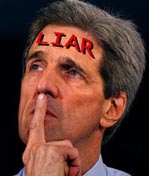
John Kerry Pic


...And I thought the bunny rabbit look was bad.


UPDATE:
It gets worse...


And worse...


Why Kerry Will Lose The Election...

I came across the following article while committed to my never enteding task of exposing the real John Kerry (or, as I like to call him, John "waffles" Kerry). Hope you enjoy it:
Why Kerry Will Lose The Election
VIEW FROM THE RIGHT

Adam Sparks
SFGate

John Kerry will lose this election, and he will do so decisively. The defeat will go down as perhaps the only thing this candidate has ever done decisively.

...

Let's be serious; the convention was a grand flop. Following the event, polls were all over the place: Some showed no postconvention increase for Kerry at all, and others had a bounce so small it was within the margin of error. But the most seriously devastating of all them all was the CNN/USA Today/Gallup poll. In that survey of likely voters, President Bush led Kerry 50 percent to 46 percent. Ouch -- that's gotta hurt. A Newsweek survey did show some good news for Kerry, who picked up a few points in that vote. The bad news? It was the most dreadful showing of any postconvention bounce in the decades since the newsmagazine began measuring such shifts.

...

This was Kerry's moment in the sun to introduce himself to Americans and talk about issues. Yet it was quite difficult among all his rhetoric to figure out what he was for or against, or what he would do differently. If he has not defined himself by now to the American people, any new self-definitions revealed as Election Day nears will be a day late and a dollar short.

...

Kerry has clearly indicated he was always against the war, but that was after his vote in favor of the war, but not for war funding, which should not be understood as support, and in any case he would have done it much differently. His concern is now a lack of any real coalition and U.N. support, but when the United States had the backing of the United Nations and a real international presence in Desert Storm after Iraq invaded Kuwait, Kerry voted against that intervention. That information should clear it up for all those undecided voters who really wanted to know.

On abortion, he's about the same: He's voted against a ban on partial-birth abortion, but he has recently declared his belief that life begins at conception. That pronouncement should get everyone on both sides of the issue to vote for him. At least we all know he's a man of his convictions, and not just poll driven, like those other big-haired, arrogant-looking politicians. Bush once characterized Kerry's popularity by saying, in effect, of course he's popular, adding, "He's been on every side of every issue." Kerry has no cohesive message.

...

Kerry has been using his "hero" status as one of his finest achievements. But, as with much of what he does, he sends mixed messages. He proudly brings out his handful of Vietnam veterans and recalls his heroics, but, earlier, he testified before Congress and wrote in his book, "Tour of Duty," that he committed war crimes, and so did most of his comrades.

...

Pity the poor guy who has to reach back 35 years to show America just how great he is. And he does so very selectively: There's no mention of all his medal ribbons tossed with contempt over the White House fence for the same war he now fondly remembers. He brought a cast of sailors out with him on the convention podium and keeps a contingent with him at all times while campaigning, either to show Americans just how patriotic he is or to remind us incessantly that he served a grueling four months in Vietnam. For whatever reason, it's pathetic. The peaceniks know all about his antiwar theatrics; he needn't highlight those attributes. He's now going after the swing voter who respects America military strength and may have or have had family members in the service. In Kerry's world, you really can be all things to all people.

Forget the showboating -- no pun intended -- let's look at the record. Kerry received three Purple Hearts, and, after four months of duty, he requested permission to get the heck out of there. However, retired Rear Adm. Roy Hoffmann, who ran the swift-boat campaign in Vietnam and now leads a group of fellow officers calling themselves the Swift Boat Veterans for Truth, countered Kerry, saying, "I do not believe that John Kerry is fit to be commander in chief of the armed forces of the United States. This is not a political issue. It is a matter of judgment, truthfulness, reliability, loyalty and trust -- all absolute tenets of command.

"Only one of his 23 fellow officers in charge from Coastal Division 11 supports John Kerry," he added. "Overall, more than 250 swift-boat veterans are on the record questioning Kerry's fitness to serve as commander in chief. That list includes his entire chain of command -- every single officer Kerry served under in Vietnam. The Kerry game plan is to ignore all this and pretend that the 13 veterans his campaign jets around the country and puts up in five-star hotels really represent the truth about his short, controversial combat tour."

You needn't go back 35 years to Vietnam to see what Kerry's all about. Just check out his voting record in the Senate, where he's been for the past 19 years. Can you name one piece of legislation he carried? Don't worry; neither can anyone else.

...

A centerpiece of Kerry's campaign is to make access to drugs and medicine affordable, but, when you hear the word affordable, hold on to your wallets. It means a health-care system that will rely on billions of dollars of tax increases to prop up. But, taking a page from John Edwards' "two Americas," as far as Kerry's concerned, only the rich should pay the taxes. But don't relax yet; "the rich" includes anyone with a job. Increasing taxes for just the wealthiest 1 percent, or even the richest 10 percent, will not pay for a singe-payer health-care system, which would cost several trillion dollars annually and would federalize one-fifth of the economy.

...

No war president has ever lost an election in the United States, and it's unlikely this will be the case now. Until recently, the Democrats uttered a great deal of rhetorical propaganda about their contention that Bush "lied" about the war of liberation in Iraq: He lied about intelligence; he lied about WMDs. He lied, lied, lied. Everyone from the head of the Democratic Party to Michael Moore has delivered this mantra for the last three years.

Now that the bipartisan 9/11 Commission has come out with its final report, which vindicated the president, you don't hear that much about lies anymore. The report says there were no lies. Bad intelligence, yes; lies, no. Unfortunately, much of the damage has been done, as Bush's "lies" have now become an urban legend, ingrained in the minds of many.

The 9/11 Commission's report, which involved the investigation and review of tens of thousands of pages of secret documents and interviews of hundreds of key witnesses, found not a single lie.

...

Full Story


New Guest Blogger

Here are two articles submitted to me from a young conservative Christian political activist, Chrstal Broyles. Hope you enjoy them.
Why Not?!
Crystal Broyles, AL
July 28, 2004

On Tuesday July the 27th at the Democratic National Convention Teresa Heinz Kerry said: "There is a value in taking a stand even if nobodynotices…" This is apparently true for the liberal left. All of the individuals in their groups seem to be advocates for their causes. But what about Christians and Conservatives? What are they doing to take a stand? Where is their center point of activism?

Teresa Heinz Kerry marveled and wowed the crowds at the Democratic National Convention last night as she spoke. Toward the closing of her speech she was talking about the "morals" her husband would bring to the White House. Among these morals she said, "It is a moral nation that leads through the power of its ideals..." She never once acknowledged God … that is until the close of her speech she said,
"God bless America". When are we as American's going to stop requesting that God bless us and instead us as American's bless God?

American revivalist, Charles Finney said, "It seems at times as if the foundations of our nation are rotten, and Christians seem to act as if they think God does not see what they do in politics. But I tell you He does see..."

When are the conservative Christians going to stop being political pacifists and start being political activists?

Mrs. Kerry said, "It is a moral nation that leads through the power of its ideals..." If John Kerry is elected president on November 2nd our nation will be lead by ideals, they just will not be the ideals of the living God. You must ask yourself, are Kerry's ideals yours?
You can sure bet that Kerry's ideals are not mine.
Back in the USSR
Crystal Broyles, AL
August, 4, 2004

How do you see America – is it the land of opportunity or the land of equality?Let's take a look at how John Kerry and John Edwards see America.

The other night as I sat listening to Vice Presidential Democratic candidate John Edwards, I said to myself, "John Edwards is a great speaker and he sure sounds nice … but what does the Kerry/Edwards "plan" consists of? Let's take a look at some highlights of their "plan".

Their "plan" will do away with:
1. The "two health care systems" that we are currently subjected to.
2. The "two school systems".
3. "Two economies".
The Kerry/Edwards agenda is clear; they want to take away the gap between the rich and the poor. They want to make all American's equal. We will have equal jobs, educations, health care…

There is a startling comparison to be found if we look back into history at the former Soviet Union. The suppressed socialistic nation of the U.S.S..R. was brought about by making all its citizens – equal. The Kerry/Edwards team has a vision for America and that vision is equality to all and for all. Their politics are the same politics that crippled the Soviet Union.

Michael Ferris, President of Patrick Henry College was lecturing last week about leaders. In this lecture he spoke about how great leaders understand and know the present through studying history. The reason why it is so important for leaders to know history is to prevent the same failures that others before you have committed.

Last week during the Democratic National Convention there were many speeches made and quite a few stories told within these speeches. When John Kerry formally accepted his nomination as the Democratic Presidential Nominee, he gave a speech and told some stories. One of the stories was about how as a child living overseas he rode his bike into Berlin, an area he was not permitted to ride his bicycle into and as a result his father punished him for his actions. At this time in history the Berlin Wall still stood and the Russians were still suffering greatly. John Kerry has seen the results of "equality for all" with his very own eyes. Mr. Kerry has not learned from history – how can he lead our nation?

The Kerry/Edwards team has a "plan" and all John Edwards wants us to know is, in his own words "hope is on the way … for our one America" Now let me ask you, is this what you want for America?
I personally have no problem with equality as it concerns oppertunity. Outside the realm of oppertunity, equality serves as an incentive not to work harder and smarter.


Dirty, Dirty, Liberals

I am shaking my head in disapproval as I write this post. Here is a pathetic, lowly, callous attack on the folks who authored Unfit For Command.

Of course, the left cannot deny the accusations and allegations brought forth in this remarkable book, so instead they attack the source and ignore the charges laid out against Kerry. I think if Kerry wants to be President of the United States, he ought to answer these charges instead of sending his minions after honorable men.

Honestly, this disgusts me.


Sunday, August 08, 2004

Did you know...?

Did you know that Kerry once served as Lt. Gov under Mike Dukakis? So what does this mean? Nothing really, except when you consider that Kerry's crew doesn't want to talk about it... so much so that they left this story out of a biography they are hyping to try to get waffle-boy elected. Why would they do that? Despite Dukakis's severe thrashing in the 84 election, it should still have been an honor for Kerry to have served in that capacity. Revision of history is really nothing new for the left, so I guess I shouldn't be too surprised.


Kerry on Iraq...

Click here to see the movie people are raving about:
"Awesome! Every American must see!"
-- Gov. Mike Huckabee (R-AR)
"Powerful..." -- Kenneth Lovett, New York Post
"Devastating..." -- Morton Kondracke, Roll Call
"...I think every American should see this..." -- Fmr. NYC Mayor Rudy Giuliani
To date, over 2.4 million have seen this video portray Kerry's flip flops and waffles on a major election issue: the war in Iraq. First he is for the war, then he is against the war, then he says it would be irresponsible to send our troops to battle unequipped, then he votes against equipping our soldiers thereby playing politics with our soldiers lives.

Check it out today!


Saturday, August 07, 2004

Multimedia Attacks on Kerry

A slide show

A movie via here <- excellent!

A book

A picture:


Friday, August 06, 2004

Kerry Slams Bush for 7 Minutes on 9/11

I was amazed to hear a portion of the conference in which John Kerry said, "Had I been reading to children and had my top aide whispered in my ear, 'America is under attack,' I would have told those kids very politely and nicely that the President of the United States had something that he needed to attend to -- and I would have attended to it." ... incredible!

My first reaction was momentary shock coupled with instantaneous anger and a profound curiosity in just what exactly would have possessed Kerry to say such a thing.

9/11 affected every American, some more profoundly than others. I'm sure we all needed a few moments to take in what was happening. Those of us who watched how the President responded (the cameras were running non-stop on the President) had the unique opportunity to witness the full range of emotions as the horrible reality sunk in with the one man on whom all eyes would be focused.

No one wanted to get that news, which had to be whispered so as not to alarm the young children, least of all the President and especially because he was in a room full of children and media. Imagine yourself as President of the United States of America. You wake up to a beautiful September morning - just a day like any other day - and you are excited, and maybe nervous, because today there are going to be cameras on you for several hours (more so than your typical day, at least). Add to that the presence of children, who are known for their predictable unpredictability. You are holding this event because you are pushing your education plan. You care an awful lot about children, you have two beautiful daughters of your own. The morning seems to be off to a good start: everything is running on time and as scheduled, the children are well-behaved, you are having a pretty good time reading with the children when you hear pagers and cell phones start buzzing. There is a slight murmur from the press and your advisor walks over to tell you that a small plane has accidentally crashed into the World Trade Center Towers. This is a bit unsettling, but nothing to be too alarmed about; after all, accidents do happen... but the location is a bit troubling. You continue your event with the children and some time later you see the cell phones and pagers start going crazy. Within moments your advisor walks over to you and says the unthinkable: A second plane has hit the other tower. America is under attack.

You are the President and you just learned that America is under attack. You look over and see every camera in the room on you. It may as well be every eye in the world. For years to come this footage will be viewed and reviewed, studied and criticized. You get the worst possible news at the worst possible time. You can't curse, you can't stand up and run out of the room, there are live cameras on you and any wrong move could create a national panic. You have a responsibility to the children in the room as well as hundreds of millions of worried Americans who are looking to you to deal with a very serious situation.

Our President took 7 minutes to let this all sink in. He knew if he acted too hurriedly he would be percieved as he already is, by some, a rash, unthinking cowboy. If he took to long he would be perceived as an ineffective coward. The look on Bush's face is as fresh in my mind today as it was on 9/11. Somewhere between the look of anger and annoyance when you could tell he wanted to be anywhere but in a room full of reading school children and press, but knew he should let the children finish so he could leave and be fully debriefed.

I think every American who watched the President that morning, that day, saw the President as a man like any other. They saw in him the same emotions that were coursing through every American that terrible morning. They saw the President beginning to change before their very eyes. Our President was forged in the fires of 9/11. He became our national leader in the days that followed. Democrats, Republicans, Firemen, Police, Teachers, Soldiers, and everyone in-between saw President Bush as a great leader. His approval ratings were among the highest ever recorded. I know we have all seen a steady decline in his numbers as Americans moved more and more to put 9/11 behind them forever, but for months Bush was our President, and all but the furthest reaches of the political left felt that way.

Speaking of the furthest reaches of the political left, Kerry somehow thinks that reminding Americans of how they felt about Bush and how Bush handled 9/11 can somehow help Kerry. Kerry thinks bringing up 9/11 can help him! Kerry thinks attacking Bush's response in the minutes that followed Bush's first learning of the attacks can somehow help him. The gall it takes to be a Monday Morning Quarterback about the leading during the worst attacks in American History... After thinking about it I became nearly outraged.

This isn't, as some think, a political weapon aimed at Bush... This was a miscalculation by Kerry. Comments like this will surely backfire, so why would the Kerry team have him say it? Unless, of course, they want to bring attention to Kerry's stupid remarks and away from, say, oh, I don't know... Swiftvets for truth and Wintersoldier.com.

I think this was a brilliant strategy. If the criticism catches on with the American people, which is a bet it won't, then Kerry has hurt Bush on what should be seen as the beginning of the shining moment in his Presidency. If the criticism backfires, which I think it will, then Kerry will take a lot of heat for his ridiculous I would have told those kids very politely and nicely that the President of the United States had something that he needed to attend to -- and I would have attended to it comment. Compared to the Swift Vet's allegations, the Kerry criticism is a tempest in a teapot... but sometimes we must start smaller controlled fires to keep larger fires from getting out of control.

I think it is possible that this comment was a calculated decision. Maybe I am way out there on this one, but that Kerry came out and said this on the day that the swiftvets started running commercials against him seems quite the coincidence. The hope could be that the conservative press would have to split their attention between two stories, one an easy, credible story which has a lot of red meat on it, and the other a slightly incredible story from a group of soldiers who are making some SERIOUS allegations, (allegations which I have been following for months now).

I guess it is up to everyone to decide for them self... but as far as I know I am the first to have come out with this particular take on yesterday's events.


Thursday, August 05, 2004

Russ's Zero Hero

Russ sent over a quick submission so I thought I'd share it... It seems Vietnam Vets have been getting a LOT of attention recently. It is about time that major media outlets (Rush, Hannity, Beck, Savage, etc) have started listening and opening up their show to Vets who speak out against Kerry. Seems that if Drudge talks about something the whole world listens... it's pretty amazing the kind of power that one voice has. Enough pontificating, I have some posts of my own to work on. Enjoy Russ's 'Zero Hero' (looks like a poem, it could be a bit longer, though)

The Zero Hero

I can't help but think when some liberal Twink
Pronounces John Kerry a hero,
That the Twink never bore any weapons of war
Or he'd know this hero's a zero.

Russ Vaughn
2d Bn, 327th Parachute Infantry Regiment
101st Airborne Division
Vietnam 65-66


John Kerry: Tough sell to Veterans

I read an excellent article over at The Washington Dispatch at the reccomendation of Russ Vaughn.

A sample to peak your interest:
John Kerry and the Democratic National Committee have gone to great lengths to show John Kerry as a war hero and the man best qualified to replace President Bush this November. For all the discussion and all the home video that John Kerry re-enacted there are almost two dozen reasons that veterans and active duty, reserve and national guard troops today should vote to re-elect George W. Bush as President of the United States.
Full Story

I especially liked reading this, which I had not previously known:
63 men who earned the nation’s highest award for valor, the Congressional Medal of Honor, are still alive today, yet not one of those men publicly support John Kerry for President of the United States. On the other hand, 14 Vietnam Congressional Medal of Honor recipients signed a letter along with 7 other recipients from the Korean War and World War II endorsing President Bush.

Check it out!

Hat Tip: Russ


Wednesday, August 04, 2004

Kerry Pics

For your viewing pleasure..


Tuesday, August 03, 2004

Mark Steyn Asks, "Could Kerry slum it in the White House?"

I found this gem while wondering around the web:
Could Kerry slum it in the White House?
By Mark Steyn
Source

During their triumphant 1939 tour of Canada, King George VI and Queen Elizabeth took a brief detour south of the border to visit the Roosevelts at Hyde Park. It was the first time a reigning monarch had set foot on American soil and, to mark the occasion, President and Mrs Roosevelt introduced the royal couple to a local delicacy called "hot dogs".

There's an important lesson there: an American president, even one as wealthy as FDR, is obligated to share the tastes of the people in a way that the House of Windsor is not, even today. Try to imagine the roles reversed: the Roosevelts at Windsor, and the King serving up jellied eels and mushy peas.

And that's the problem with John Kerry: it's not that he's rich, but that he's rich in a very un-American way. His swank has a European air about it.

When he eats a hot dog, it appears as foreign to him as it did to George VI.
I've never had the oppertunity to see Kerry eat a hot dog; however, I do remember seeing him eat a hoagie


But I digress, back to the article which was already in progress
...

Case in point: on Friday, the Kerry campaign bus was passing through Newburgh, north of New York, and stopped at the local Wendy's. That's a fast-food chain. I used to prefer them to McDonald's and Burger King, because they used square patties between round buns and it was fun to nibble the corners off. Hence the last time Wendy's figured in a presidential campaign, 20 years ago, when Walter Mondale appropriated their taunt to their competitors and turned it on Ronald Reagan: "Where's the beef?" The preceding explanation is for the benefit of British readers. It should not be necessary to explain what Wendy's is to any American, even presidential candidates.

So the campaign team dropped in at the burger joint. Elizabeth Edwards, the wife of Kerry's running mate, had told a heartwarming personal anecdote at the Democratic convention about how every anniversary she and her husband celebrate at Wendy's, because on their wedding night it was the only restaurant they could afford to eat at.

John Edwards's campaign theme is a slice of warmed-over Disraeli: there are "two Americas", one for the rich, one for the poor, and, even though he's part of the former, he wants you to know that he started out in the latter. Friday was the Edwardses' 27th anniversary, so, in keeping with tradition, they hit the Newburgh Wendy's, along with the Kerrys, campaign mascot Ben Affleck and accompanying press crew.

The photo-op didn't go smoothly. Kerry went over to say hi to some marines, who turned out to be Bush supporters and resented the interruption to their lunch. More telling was Teresa Heinz Kerry. She pointed to the picture of the bowl of chilli above the clerk's head: "What's that?" she asked. He explained that it was something called "chilli" and she said she'd like to try a bowl. The Senator also ordered a Frosty, a chocolate dessert. They toyed with them after a fashion, and then got back on the bus.

It then emerged that Wendy's had just been an appetiser. The campaign advance team had ordered 19 five-star lunches from the Newburgh Yacht Club for Kerry, Edwards, Affleck and co to be served back on the bus: shrimp vindaloo, grilled diver sea scallops, prosciutto, wrapped stuffed chicken, etc.

I'm not sure whether Ben had the shrimp and Teresa the scallops, but, either way, it turns out John Edwards is right: there are two Americas - one America where folks eat at Wendy's, another America where the elite pass an amusing half-hour slumming among the folks at Wendy's and then chow down on the Newburgh Yacht Club's specials of the day. The Elizabeth Edwards anniversary-at-Wendy's shtick was meant to emphasise her husband's authenticity, but it now looks as inauthentic as Kerry's own blundering "regular guy" routine.

...

On reflection, I now see there might indeed be something to the idea of a remote privileged class hermetically sealed off from the masses. Unfortunately, John Kerry seems to be the best living exemplar of it. He may not enjoy eating at Wendy's, but his faux lunch order captures the essence of his crowd-working style: chilli and Frosty. If I were the Wendy's marketing director, I'd make it the John Kerry Special from now through election day.

...

The tonal disconnect is only going to get worse between now and November. At the convention last week, Ted Kennedy urged Americans to make sure that, this January, John Kerry has a "nice new home". But, thanks to his wife's first husband, he already has five multi-million-dollar homes, including a 15th-century stone barn dismantled and shipped over from England to serve as their ski chalet in Idaho.

By contrast, George W Bush has one modest ranch in Crawford, a town no one would choose to live in unless it genuinely was his home. As Noemi Emery put it in the Weekly Standard, Kerry is not just "the richest man ever to run on a national ticket", but also "the most self-indulgent in his lifestyle, and the most quasi-royal in his sense of himself".

That gives a whiff of condescension to his chant of "Help Is On The Way", a slogan already a tad too crudely nanny-statish. On the other hand, it's a very good catchphrase for Senator Kerry if he's back at the 15th-century ski chalet in Idaho and Teresa is complaining because she rang for a Scotch five minutes ago. "Don't be so impatient, lovie. The help is on the way."
Source


I only took out a few paragraphs, a few lines really, as I like to respect copyrights as much as possible on E*D; but this article was so well written and the content so needs to be shared that I felt the greater crime would be in cutting out too many lines. Be that as it may, I suggest everyone check out the piece in it's entirity and click on their advertiser's links.


E*D welcomes Guest Commentary

I love to post articles (especially original articles) written by folks who visit Esoteric * Diatribe. I don't post everything that is submitted, but I do appreciate every sumbission. So the next few posts will be sumbissions I've recieved in the past week.

The first post is from Jason, a young conservative felow who lives in Michigan, near the Ohio border (Michigan and Ohio are both considered battleground states).
Hey Ken,

I don't know if you heard, but John Kerry made a stop in Bowling Green on Sunday, August 1st. The family and I tried to go see him, but we couldn’t get near the event. You see, Kerry decided to speak in the center of town with the historic buildings as a backdrop. This made the space compact to the point where, on camera, it would look like there were many, many people there.

Of course, any SMART politician would know that you actually want to have a large crowd, not a seemingly large crowd, but I guess Kerry doesn't fall into this category.

What Kerry should have done was:

First, he should have held the speech inside the BG stadium, which could have actually held a large crowd. What looks more impressive, a STREET full of people, or a FOOTBALL STADIUM full of people? Secondly, it was about 85 degrees that day, and a lot of people had to be taken to the hospital. Wouldn't it have made sense to hold it in the STADIUM, were people could have sat down, and had partial shade? Third, the majority of the people couldn't get in, and were pretty MAD. This could just be me, but wouldn't a politician want lots of HAPPY people, who would want to vote for him? Especially since the state this took state is so crucial for Kerry! No Republican has won without taking Ohio, so if Kerry could take Ohio, it could be the end for Bush.

It seems to me that Kerry is just giving a show for the registered Democrats that already support him, not the coveted group of Independents, from whence come many of the key votes in a Presidential Election?

John Kerry, you think you're smart, well SHOVE IT!

Jason
Sorry you didn't get to see the Waffler in action, Jason. I doubt you missed anything of substance. The Dems are all about cold, calculated political decisions. They know that more people read about a rally or watch it on TV than actualy attend it, so appearances are everything. They don't care what happens, just what appears to be happening. They know Kerry doesn't have enough support in Ohio to fill the BG stadium, and they could care less about everyday people who have to stand in the heat to hear Kerry blather on about his various shifting positions, flop flops, and waffles. You are right, it would have been nice if Kerry would have provided a venue with seating, shade, perhaps even supplied water, but this assumes Kerry cares about anyone except Kerry. Thanks for the heads up, Jason.


Another submission from Russ Vaughn:
For The Children
Why don't we consider for a moment just whom John Kerry's false testimony before Congress actually did affect in American society. Was it just those uniformed unfortunates who served their country, ably, honorably and well? Or did it, perhaps, extend beyond that? And how might it have affected our populace in more invidious ways?

I would ask this question:

How many children grew up in the last thirty years of the 20th Century casting covert glances at their fathers, uncles and grandfathers, because those individuals bore the label of "Vietnam Vet?" How many of those children wondered if that gentle, tender man who cuddled them, told them bedtime stories, and kissed them good night, had, in fact, been a killer of children just like themselves, but of a duskier hue? Not a comforting thought at bedtime for the little ones, is it, folks?

But that is precisely what the present Democrat candidate for the presidency of the United States of America, John Kerry, told our nation and told our children. He went before our Congress and testified that all who served in Vietnam were guilty of child killing, child rape, and much worse. And in so doing he drove a hard, cold spike of doubt into the hearts and minds of countless young children throughout this nation. He made those innocents look at their fathers, uncles and grandfathers with distrust and doubt. And worry. And fear.

And why? Purely, simply, for nothing more than his own political gain. This man who now wants you to elevate him to the ultimate position of power, deliberately, callously, and selfishly, drove this wedge of doubt between all those returned, honorable warriors and their offspring, as well as their spouses, their siblings and even their parents. For nothing more than his unrelenting aspiration to be president of the United States, this jerk went before Congress and the media cameras and falsely accused those of us who had served our nation honorably of despicable crimes. Without question, John Kerry, more than any other American, is responsible for this terrible, horrendous charge of criminality, which haunts Vietnam veterans and their families to this day.

No one really took Jane Fonda seriously; she was just a spoiled, rich, airhead young actress. Despicable? Yes. Believable? No. But not so John Kerry. Here was an Ivy League educated young warrior fresh back from the fight, bearing medals attesting to his wounds and his valor. Here was a blooded, first person witness with medals and legitimate combat credentials, someone who truly knew of what he spoke. And what did he say? He testified to the nation and the world that we were war criminals, up and down the chain of command, all of us, guilty of the most vile, debased depredations imaginable against the civilians of Vietnam.

He lied.

He lied before Congress then, and he lies to the American public now. This phony hero, who once admitted to personal war crimes in that unfortunate Southeast Asian war, now trumpets his service there, holding it up as a badge of his worthiness to be our Commander in Chief in time of war. This wannabee hero, this cheesy weasel who forced his boat crew to film his re-enacted, heroic exploits, this man who illegally negotiated with the enemy in Paris, this despicable prick who caused countless, unneeded American casualties, this callous, unfeeling jerk who brought pain and suffering to those Americans still being held in enemy prisons, now wants us to join his band of brothers?

Well, this brother thinks not, John. Shame should have some limits. Obviously, Kerry doesn't.

And all those children still wonder.

Russ Vaughn
327th Parachute Infantry Regiment
101st Airborne Division
Vietnam 65-66
Russ, I couldn't agree more. Kerry's lies about war attrocities have had serious, far reaching consequences. Kerry does not deserve to be president!


Russ found an article he wanted to share with E*D.
23 Apr 04 - The enclosed article was written by LtCol M.R. Strobl USMC who is assigned to MCCDC Quantico, VA and served as the officer who escorted the remains of PFC C. Phelps USMC from Dover AFB, DE to his home. PFC Phelps was assigned to 3d Bn, 11th Marines - an artillery unit functioning as a provisional infantry battalion during Operation IRAQI FREEDOM 2. PFC Phelps was killed in action from a gunshot wound received on 9 Apr 04 during combat operations west of Baghdad. He was buried in Dubois, WY on 17 Apr 04.

The following is Marine Lieutenant Colonel Strobl's account of escorting the remains of Lance Corporal Chance Phelps.
Taking Chance
Chance Phelps was wearing his St. Christopher medal when he was killed on Good Friday. Eight days later I handed the medallion to his mother. I didn't know Chance before he died. Today I miss him.

Over a year ago, I volunteered to escort the remains of Marines killed in Iraq should the need arise. The military provides a uniformed escort for all casualties to ensure they are delivered safely to the next of kin and are treated with dignity and respect along the way.

Thankfully, I hadn't been called on to be an escort since Operation Iraqi Freedom began. The first few weeks of April, however, had been a tough month for the Marines. On the Monday after Easter I was reviewing Department of Defense press releases when I saw that a Private First Class Chance Phelps was killed in action outside of Baghdad. The press release listed his hometown?the same town I'm from. I notified our Battalion adjutant and told him that, should the duty to escort PFC Phelps fall to our Battalion, I would take him. I didn't hear back the rest of Monday and all day Tuesday until 1800. The battalion duty NCO called my cell phone and said I needed to be ready to leave for Dover Air Force base at 1900 in order to escort the remains of PFC Phelps.

Before leaving for Dover I called the major who had the task of informing Phelps's parents of his death. The major said the funeral was going to be in Dubois, Wyoming. (It turned out that PFC Phelps only lived in my hometown for his senior year of high school.) I had never been to Wyoming and had never heard of Dubois.

With two other escorts from Quantico, I got to Dover AFB at 2330 on Tuesday night. First thing on Wednesday we reported to the mortuary at the base. In the escort lounge there were about half a dozen Army soldiers and about an equal number of Marines waiting to meet up with "their" remains for departure. PFC Phelps was not ready, however, and I was told to come back on Thursday. Now, at Dover with nothing to do and a solemn mission ahead, I began to get depressed.

I was wondering about Chance Phelps. I didn't know anything about him; not even what he looked like. I wondered about his family and what it would be like to meet them. I did pushups in my room until I couldn't do any more.

On Thursday morning I reported back to the mortuary. This time there was a new group of Army escorts and a couple of the Marines who had been there Wednesday. There was also an Air Force captain there to escort his brother home to San Diego.

We received a brief covering our duties, the proper handling of the remains, the procedures for draping a flag over a casket, and of course, the paperwork attendant to our task. We were shown pictures of the shipping container and told that each one contained, in addition to the casket, a flag. I was given an extra flag since Phelps's parents were divorced. This way they would each get one. I didn't like the idea of stuffing the flag into my luggage but I couldn't see carrying a large flag, folded for presentation to the next of kin, through an airport while in my Alpha uniform. It barely fit into my suitcase.

It turned out that I was the last escort to leave on Thursday. This meant that I repeatedly got to participate in the small ceremonies that mark all departures from the Dover AFB mortuary. Most of the remains are taken from Dover AFB by hearse to the airport in Philadelphia for air transport to their final destination. When the remains of a service member are loaded onto a hearse and ready to leave the Dover mortuary, there is an announcement made over the building's intercom system. With the announcement, all service members working at the mortuary, regardless of service branch, stop work and form up along the driveway to render a slow ceremonial salute as the hearse departs. Escorts also participated in each formation until it was their time to leave.

On this day there were some civilian workers doing construction on the mortuary grounds. As each hearse passed, they would stop working and place their hard hats over their hearts. This was my first sign that my mission with PFC Phelps was larger than the Marine Corps and that his family and friends were not grieving alone.

Eventually I was the last escort remaining in the lounge. The Marine Master Gunnery Sergeant in charge of the Marine liaison there came to see me. He had Chance Phelps's personal effects. He removed each item; a large watch, a wooden cross with a lanyard, two loose dog tags, two dog tags on a chain, and a Saint Christopher medal on a silver chain. Although we had been briefed that we might be carrying some personal effects of the deceased, this set me aback. Holding his personal effects, I was starting to get to know Chance Phelps.

Finally we were ready. I grabbed my bags and went outside. I was somewhat startled when I saw the shipping container, loaded three-quarters of the way in to the back of a black Chevy Suburban that had been modified to carry such cargo. This was the first time I saw my "cargo" and I was surprised at how large the shipping container was. The Master Gunnery Sergeant and I verified that the name on the container was Phelps's then they pushed him the rest of the way in and we left. Now it was PFC Chance Phelps's turn to receive the military-and construction workers'-honors. He was finally moving towards home.

As I chatted with the driver on the hour-long trip to Philadelphia, it became clear that he considered it an honor to be able to contribute in getting Chance home. He offered his sympathy to the family. I was glad to finally be moving yet apprehensive about what things would be like at the airport. I didn't want this package to be treated like ordinary cargo, but I knew that the simple logistics of moving around a box this large would have to overrule my preferences.

When we got to the Northwest Airlines cargo terminal at the Philadelphia airport, the cargo handler and hearse driver pulled the shipping container onto a loading bay while I stood to the side and executed a slow salute. Once Chance was safely in the cargo area, and I was satisfied that he would be treated with due care and respect, the hearse driver drove me over to the passenger terminal and dropped me off.

As I walked up to the ticketing counter in my uniform, a Northwest employee started to ask me if I knew how to use the automated boarding pass dispenser. Before she could finish another ticketing agent interrupted her. He told me to go straight to the counter then explained to the woman that I was a military escort. She seemed embarrassed. The woman behind the counter already had tears in her eyes as I was pulling out my government travel voucher. She struggled to find words but managed to express her sympathy for the family and thank me for my service. She upgraded my ticket to first class.

After clearing security, I was met by another Northwest Airline employee at the gate. She told me a representative from cargo would be up to take me down to the tarmac to observe the movement and loading of PFC Phelps. I hadn't really told any of them what my mission was but they all knew.

When the man from the cargo crew met me, he, too, struggled for words. On the tarmac, he told me stories of his childhood as a military brat and repeatedly told me that he was sorry for my loss. I was starting to understand that, even here in Philadelphia, far away from Chance's hometown, people were mourning with his family.

On the tarmac, the cargo crew was silent except for occasional instructions to each other. I stood to the side and saluted as the conveyor moved Chance to the aircraft. I was relieved when he was finally settled into place. The rest of the bags were loaded and I watched them shut the cargo bay door before heading back up to board the aircraft.

One of the pilots had taken my carry-on bag himself and had it stored next to the cockpit door so he could watch it while I was on the tarmac. As I boarded the plane, I could tell immediately that the flight attendants had already been informed of my mission. They seemed a little choked up as they led me to my seat.

About 45 minutes into our flight I still hadn't spoken to anyone except to tell the first class flight attendant that I would prefer water. I was surprised when the flight attendant from the back of the plane suddenly appeared and leaned down to grab my hands. She said, "I want you to have this" as she pushed a small gold crucifix, with a relief of Jesus, into my hand. It was her lapel pin and it looked somewhat worn. I suspected it had been hers for quite some time. That was the only thing she said to me the entire flight.

When we landed in Minneapolis, I was the first one off the plane. The pilot himself escorted me straight down the side stairs of the exit tunnel to the tarmac. The cargo crew there already knew what was on this plane. They were unloading some of the luggage when an Army sergeant, a fellow escort who had left Dover earlier that day, appeared next to me. His "cargo" was going to be loaded onto my plane for its continuing leg. We stood side by side in the dark and executed a slow salute as Chance was removed from the plane. The cargo crew at Minneapolis kept Phelps's shipping case separate from all the other luggage as they waited to take us to the cargo area. I waited with the soldier and we saluted together as his fallen comrade was loaded onto the plane.

My trip with Chance was going to be somewhat unusual in that we were going to have an overnight stopover. We had a late start out of Dover and there was just too much traveling ahead of us to continue on that day. (We still had a flight from Minneapolis to Billings, Montana, then a five-hour drive to the funeral home. That was to be followed by a 90-minute drive to Chance's hometown.)

I was concerned about leaving him overnight in the Minneapolis cargo area. My ten-minute ride from the tarmac to the cargo holding area eased my apprehension. Just as in Philadelphia, the cargo guys in Minneapolis were extremely respectful and seemed honored to do their part. While talking with them, I learned that the cargo supervisor for Northwest Airlines at the Minneapolis airport is a Lieutenant Colonel in the Marine Corps Reserves. They called him for me and let me talk to him.

Once I was satisfied that all would be okay for the night, I asked one of the cargo crew if he would take me back to the terminal so that I could catch my hotel's shuttle. Instead, he drove me straight to the hotel himself. At the hotel, the Lieutenant Colonel called me and said he would personally pick me up in the morning and bring me back to the cargo area.

Before leaving the airport, I had told the cargo crew that I wanted to come back to the cargo area in the morning rather than go straight to the passenger terminal. I felt bad for leaving Chance overnight and wanted to see the shipping container where I had left it for the night. It was fine.

The Lieutenant Colonel made a few phone calls then drove me around to the passenger terminal. I was met again by a man from the cargo crew and escorted down to the tarmac. The pilot of the plane joined me as I waited for them to bring Chance from the cargo area. The pilot and I talked of his service in the Air Force and how he missed it.

I saluted as Chance was moved up the conveyor and onto the plane. It was to be a while before the luggage was to be loaded so the pilot took me up to the board the plane where I could watch the tarmac from a window. With no other passengers yet on board, I talked with the flight attendants and one of the cargo guys. He had been in the Navy and one of the attendants had been in the Air Force. Everywhere I went, people were continuing to tell me their relationship to the military. After all the baggage was aboard, I went back down to the tarmac, inspected the cargo bay, and watched them secure the door.

When we arrived at Billings, I was again the first off the plane. This time Chance's shipping container was the first item out of the cargo hold. The funeral director had driven five hours up from Riverton, Wyoming to meet us. He shook my hand as if I had personally lost a brother.

We moved Chance to a secluded cargo area. Now it was time for me to remove the shipping container and drape the flag over the casket. I had predicted that this would choke me up but I found I was more concerned with proper flag etiquette than the solemnity of the moment. Once the flag was in place, I stood by and saluted as Chance was loaded onto the van from the funeral home. I was thankful that we were in a small airport and the event seemed to go mostly unnoticed. I picked up my rental car and followed Chance for five hours until we reached Riverton. During the long trip I imagined how my meeting with Chance's parents would go. I was very nervous about that.

When we finally arrived at the funeral home, I had my first face to face meeting with the Casualty Assistance Call Officer. It had been his duty to inform the family of Chance's death. He was on the Inspector/Instructor staff of an infantry company in Salt Lake City, Utah and I knew he had had a difficult week.

Inside I gave the funeral director some of the paperwork from Dover and discussed the plan for the next day. The service was to be at 1400 in the high school gymnasium up in Dubois, population about 900, some 90 miles away. Eventually, we had covered everything. The CACO had some items that the family wanted to be inserted into the casket and I felt I needed to inspect Chance's uniform to ensure everything was proper. Although it was going to be a closed casket funeral, I still wanted to ensure his uniform was squared away.

Earlier in the day I wasn't sure how I'd handle this moment. Suddenly, the casket was open and I got my first look at Chance Phelps. His uniform was immaculate-a tribute to the professionalism of the Marines at Dover. I noticed that he wore six ribbons over his marksmanship badge; the senior one was his Purple Heart. I had been in the Corps for over 17 years, including a combat tour, and was wearing eight ribbons. This Private First Class, with less than a year in the Corps, had already earned six.

The next morning, I wore my dress blues and followed the hearse for the trip up to Dubois. This was the most difficult leg of our trip for me. I was bracing for the moment when I would meet his parents and hoping I would find the right words as I presented them with Chance's personal effects.

We got to the high school gym about four hours before the service was to begin. The gym floor was covered with folding chairs neatly lined in rows. There were a few townspeople making final preparations when I stood next to the hearse and saluted as Chance was moved out of the hearse. The sight of a flag-draped coffin was overwhelming to some of the ladies.

We moved Chance into the gym to the place of honor. A Marine sergeant, the command representative from Chance's battalion, met me at the gym. His eyes were watery as he relieved me of watching Chance so that I could go eat lunch and find my hotel.

At the restaurant, the table had a flier announcing Chance's service. Dubois High School gym; two o' clock. It also said that the family would be accepting donations so that they could buy flak vests to send to troops in Iraq.

I drove back to the gym at a quarter after one. I could've walked-you could walk to just about anywhere in Dubois in ten minutes. I had planned to find a quiet room where I could take his things out of their pouch and untangle the chain of the Saint Christopher medal from the dog tag chains and arrange everything before his parents came in. I had twice before removed the items from the pouch to ensure they were all there-even though there was no chance anything could've fallen out. Each time, the two chains had been quite tangled. I didn't want to be fumbling around trying to untangle them in front of his parents. Our meeting, however, didn't go as expected.

I practically bumped into Chance's step-mom accidentally and our introductions began in the noisy hallway outside the gym. In short order I had met Chance's step-mom and father followed by his step-dad and, at last, his mom. I didn't know how to express to these people my sympathy for their loss and my gratitude for their sacrifice. Now, however, they were repeatedly thanking me for bringing their son home and for my service. I was humbled beyond words.

I told them that I had some of Chance's things and asked if we could try to find a quiet place. The five of us ended up in what appeared to be a computer lab-not what I had envisioned for this occasion.

After we had arranged five chairs around a small table, I told them about our trip. I told them how, at every step, Chance was treated with respect, dignity, and honor. I told them about the staff at Dover and all the folks at Northwest Airlines. I tried to convey how the entire Nation, from Dover to Philadelphia, to Minneapolis, to Billings, and Riverton expressed grief and sympathy over their loss.

Finally, it was time to open the pouch. The first item I happened to pull out was Chance's large watch. It was still set to Baghdad time. Next were the lanyard and the wooden cross. Then the dog tags and the Saint Christopher medal. This time the chains were not tangled. Once all of his items were laid out on the table, I told his mom that I had one other item to give them. I retrieved the flight attendant's crucifix from my pocket and told its story. I set that on the table and excused myself. When I next saw Chance's mom, she was wearing the crucifix on her lapel.

By 1400 most of the seats on the gym floor were filled and people were finding seats in the fixed bleachers high above the gym floor. There were a surprising number of people in military uniform. Many Marines had come up from Salt Lake City. Men from various VFW posts and the Marine Corps League occupied multiple rows of folding chairs. We all stood as Chance's family took their seats in the front.

It turned out that Chance's sister, a Petty Officer in the Navy, worked for a Rear Admiral-the Chief of Naval Intelligence-at the Pentagon. The Admiral had brought many of the sailors on his staff with him to Dubois pay respects to Chance and support his sister. After a few songs and some words from a Navy Chaplain, the Admiral took the microphone and told us how Chance had died.

Chance was an artillery cannoneer and his unit was acting as provisional military police outside of Baghdad. Chance had volunteered to man a .50 caliber machine gun in the turret of the leading vehicle in a convoy. The convoy came under intense fire but Chance stayed true to his post and returned fire with the big gun, covering the rest of the convoy, until he was fatally wounded.

Then the commander of the local VFW post read some of the letters Chance had written home. In letters to his mom he talked of the mosquitoes and the heat. In letters to his stepfather he told of the dangers of convoy operations and of receiving fire.

The service was a fitting tribute to this hero. When it was over, we stood as the casket was wheeled out with the family following. The casket was placed onto a horse-drawn carriage for the mile-long trip from the gym, down the main street, then up the steep hill to the cemetery. I stood alone and saluted as the carriage departed the high school. I found my car and joined Chance's convoy.

The town seemingly went from the gym to the street. All along the route, the people had lined the street and were waving small American flags. The flags that were otherwise posted were all at half-staff. For the last quarter mile up the hill, local boy scouts, spaced about 20 feet apart, all in uniform, held large flags. At the foot of the hill, I could look up and back and see the enormity of our procession. I wondered how many people would be at this funeral if it were in, say, Detroit or Los Angeles-probably not as many as were here in little Dubois, Wyoming.

The carriage stopped about 15 yards from the grave and the military pall bearers and the family waited until the men of the VFW and Marine Corps league were formed up and school busses had arrived carrying many of the people from the procession route. Once the entire crowd was in place, the pallbearers came to attention and began to remove the casket from the caisson. As I had done all week, I came to attention and executed a slow ceremonial salute as Chance was being transferred from one mode of transport to another.

From Dover to Philadelphia; Philadelphia to Minneapolis; Minneapolis to Billings; Billings to Riverton; and Riverton to Dubois we had been together. Now, as I watched them carry him the final 15 yards, I was choking up. I felt that, as long as he was still moving, he was somehow still alive.

Then they put him down above his grave. He had stopped moving.

Although my mission had been officially complete once I turned him over to the funeral director at the Billings airport, it was his placement at his grave that really concluded it in my mind. Now, he was home to stay and I suddenly felt at once sad, relieved, and useless.

The chaplain said some words that I couldn't hear and two Marines removed the flag from the casket and slowly folded it for presentation to his mother. When the ceremony was over, Chance's father placed a ribbon from his service in Vietnam on Chance's casket. His mother approached the casket and took something from her blouse and put it on the casket. I later saw that it was the flight attendant's crucifix. Eventually friends of Chance's moved closer to the grave. A young man put a can of Copenhagen on the casket and many others left flowers.

Finally, we all went back to the gym for a reception. There was enough food to feed the entire population for a few days. In one corner of the gym there was a table set up with lots of pictures of Chance and some of his sports awards. People were continually approaching me and the other Marines to thank us for our service. Almost all of them had some story to tell about their connection to the military. About an hour into the reception, I had the impression that every man in Wyoming had, at one time or another, been in the service.

It seemed like every time I saw Chance's mom she was hugging a different well wisher. As time passed, I began to hear people laughing. We were starting to heal.

After a few hours at the gym, I went back to the hotel to change out of my dress blues. The local VFW post had invited everyone over to "celebrate Chance's life." The Post was on the other end of town from my hotel and the drive took less than two minutes. The crowd was somewhat smaller than what had been at the gym but the Post was packed.

Marines were playing pool at the two tables near the entrance and most of the VFW members were at the bar or around the tables in the bar area. The largest room in the Post was a banquet/dinning/dancing area and it was now called "The Chance Phelps Room." Above the entry were two items: a large portrait of Chance in his dress blues and the Eagle, Globe, & Anchor. In one corner of the room there was another memorial to Chance. There were candles burning around another picture of him in his blues. On the table surrounding his photo were his Purple Heart citation and his Purple Heart medal. There was also a framed copy of an excerpt from the Congressional Record. This was an elegant tribute to Chance Phelps delivered on the floor of the United States House of Representatives by Congressman Scott McInnis of Colorado. Above it all was a television that was playing a photo montage of Chance's life from small boy to proud Marine.

I did not buy a drink that night. As had been happening all day, indeed all week, people were thanking me for my service and for bringing Chance home. Now, in addition to words and handshakes, they were thanking me with beer. I fell in with the men who had handled the horses and horse-drawn carriage. I learned that they had worked through the night to groom and prepare the horses for Chance's last ride. They were all very grateful that they were able to contribute.

After a while we all gathered in the Chance Phelps room for the formal dedication. The Post commander told us of how Chance had been so looking forward to becoming a Life Member of the VFW. Now, in the Chance Phelps Room of the Dubois, Wyoming post, he would be an eternal member. We all raised our beers and the Chance Phelps room was christened.

Later, as I was walking toward the pool tables, a Staff Sergeant from the Reserve unit in Salt Lake grabbed me and said, "Sir, you gotta hear this." There were two other Marines with him and he told the younger one, a Lance Corporal, to tell me his story. The Staff Sergeant said the Lance Corporal was normally too shy and modest to tell it but now he'd had enough beer to overcome his usual tendencies.

As the Lance Corporal started to talk, an older man joined our circle. He wore a baseball cap that indicated he had been with the 1st Marine Division in Korea. Earlier in the evening he had told me about one of his former commanding officers; a Colonel Puller.

So, there I was, standing in a circle with three Marines recently returned from fighting with the 1st Marine Division in Iraq and one not so recently returned from fighting with the 1st Marine Division in Korea. I, who had fought with the 1st Marine Division in Kuwait, was about to gain a new insight into our Corps.

The young Lance Corporal began to tell us his story. At that moment, in this circle of current and former Marines, the differences in our ages and ranks dissipated-we were all simply Marines.

His squad had been on a patrol through a city street. They had taken small arms fire and had literally dodged an RPG round that sailed between two Marines. At one point they received fire from behind a wall and had neutralized the sniper with a SMAW round. The back blast of the SMAW, however, kicked up a substantial rock that hammered the Lance Corporal in the thigh; only missing his groin because he had reflexively turned his body sideways at the shot.

Their squad had suffered some wounded and was receiving more sniper fire when suddenly he was hit in the head by an AK-47 round. I was stunned as he told us how he felt like a baseball bat had been slammed into his head. He had spun around and fell unconscious. When he came to, he had a severe scalp wound but his Kevlar helmet had saved his life. He continued with his unit for a few days before realizing he was suffering the effects of a severe concussion.

As I stood there in the circle with the old man and the other Marines, the Staff Sergeant finished the story. He told of how this Lance Corporal had begged and pleaded with the Battalion surgeon to let him stay with his unit. In the end, the doctor said there was just no way-he had suffered a severe and traumatic head wound and would have to be med'evaced.

The Marine Corps is a special fraternity. There are moments when we are reminded of this. Interestingly, those moments don't always happen at awards ceremonies or in dress blues at Birthday Balls. I have found, rather, that they occur at unexpected times and places: next to a loaded moving van at Camp Lejeune's base housing, in a dirty CP tent in northern Saudi Arabia, and in a smoky VFW post in western Wyoming.

After the story was done, the Lance Corporal stepped over to the old man, put his arm over the man's shoulder and told him that he, the Korean War vet, was his hero. The two of them stood there with their arms over each other's shoulders and we were all silent for a moment. When they let go, I told the Lance Corporal that there were recruits down on the yellow footprints tonight that would soon be learning his story.

I was finished drinking beer and telling stories. I found Chance's father and shook his hand one more time. Chance's mom had already left and I deeply regretted not being able to tell her goodbye.

I left Dubois in the morning before sunrise for my long drive back to Billings. It had been my honor to take Chance Phelps to his final post. Now he was on the high ground overlooking his town.

I miss him.

Regards,
LtCol Strobl


Google
Web Esoteric * Diatribe
Great Americans
Ronald Reagan
Dr. Martin Luther King, Jr.
Frederick Douglas
This list will continue to grow.
Suggest a Great American.
See rules.
Email
Have something to say?
email me

Proud to have been assciated with:


RightNation.US America's #1 Conservative Community


Archives

This page is powered by Blogger. Isn't yours?

Listed on BlogShares
Blog Roll
(some of this is reciprocal, others are sites I just like to read)
Evangelical Outpost
Powerline
A Perfect Contradiction
Discerning Texan
Incessant Rant
Conservative Eyes
Jeff Blanco
Tom Metzger Family
Boston Brat
Secure Liberty
Big White Hat
The View From The Core


line em up.... knock em down